

Dear [name redacted],
I hear you when you say ICE is “just law enforcement,” and I want to engage with that seriously, because the comparison matters—and it breaks down in ways that should concern anyone who values the rule of law, regardless of where they stand on immigration policy.
Where ICE Does Resemble Law Enforcement
Let’s start with the fair part of the comparison. ICE agents are federally authorized law enforcement officers. They carry badges and firearms. They undergo academy training. Their authority derives from the Immigration and Nationality Act, and Congress has granted them statutory power to arrest individuals they have reason to believe are in violation of immigration law.1 They can conduct vehicle stops. They can make warrantless arrests in public when they believe someone is removable and likely to flee.2 In these respects, ICE is functionally a law enforcement agency—nobody credible disputes that.
Where the Comparison Falls Apart: Structural Differences
But there are critical structural differences between ICE and every other law enforcement agency you’ve ever interacted with, and these aren’t trivial.
First, immigration enforcement is overwhelmingly civil, not criminal. This matters enormously, because civil proceedings carry far fewer protections. When a police officer arrests you for a crime, you have a right to an attorney. In civil immigration proceedings, you don’t—the government is not required to provide you one, even though the consequence (deportation, indefinite detention, family separation) can be as life-altering as any criminal sentence.3 You can be detained for months or years while your case is adjudicated, without the procedural safeguards we take for granted in criminal court.
Second, ICE operates largely on administrative warrants—documents signed by ICE’s own officials, not by a judge or magistrate. A police detective who wants to arrest you needs to convince a neutral judge that probable cause exists. ICE issues its own warrants internally. These administrative warrants don’t authorize entry into a home (only judicial warrants do), but they are routinely used to detain people in public spaces and workplaces without any judicial review whatsoever.4 This is a fundamentally different accountability structure than what governs your local police department.
Third, there is no right to a speedy trial. People can sit in immigration detention for months with no hearing. The government has argued—and in some cases succeeded—that certain categories of noncitizens are subject to mandatory detention with no bond hearing at all, even people who have lived and worked lawfully in the U.S. for decades.5
Where ICE Is Acting Unlike Any Law Enforcement Agency in Modern American History
Now, beyond these structural differences, look at how ICE is actually behaving right now. This is where “just law enforcement” becomes impossible to defend with a straight face.
Masking and Refusal to Identify
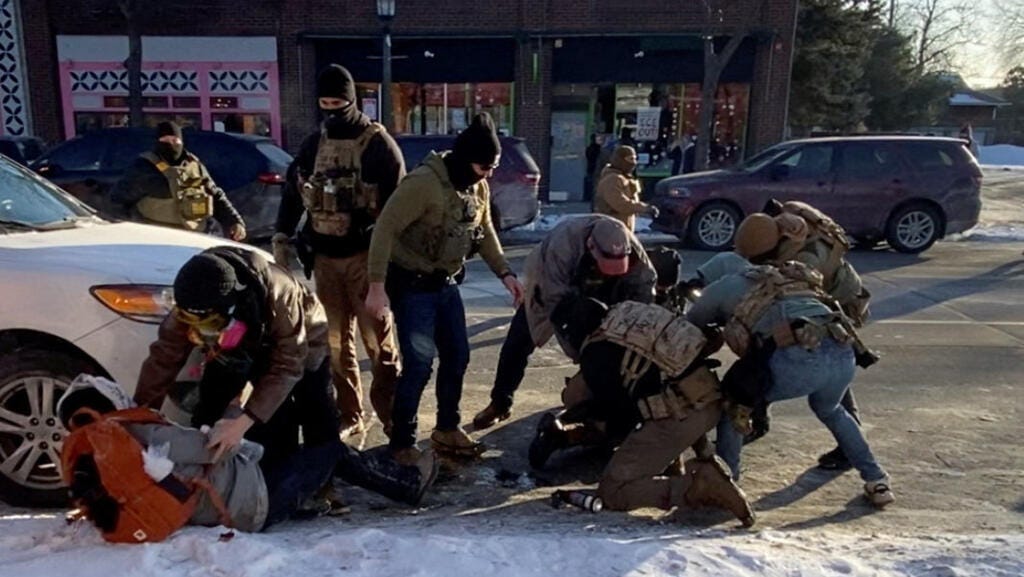
ICE agents are now routinely conducting arrests wearing ski masks and balaclavas, in plainclothes, without visible badges, and refusing to identify themselves when asked.6 This is not how law enforcement works. Your local police officer wears a uniform, displays a badge number, and can be identified and reported for misconduct. The former acting director of ICE under President Obama said he never saw agents wearing masks during his tenure—the practice began in March 2025.7
Human Rights Watch has documented 18 cases of people arrested by unidentifiable individuals who couldn’t tell if they were being detained by the government or kidnapped. In one case, a woman named Öztürk was grabbed on the street by masked people who seized her phone and backpack and handcuffed her; when she asked to see their badges, one flashed a gold necklace. She later said: “I didn’t think that they were the police because I had never seen police approach and take someone away like this.”8
The FBI issued a nationwide bulletin after criminals began successfully impersonating ICE agents—because when real agents look indistinguishable from criminals, that’s what happens. In North Carolina, a man impersonated an ICE officer to sexually assault a woman. In Pittsburgh, a man broke into a home through a kitchen window claiming to be ICE while wielding a knife.9
Multiple states have now passed or introduced laws requiring ICE agents to identify themselves, and the federal government is suing to block those laws.10 As one Chicago community organizer put it: “If you don’t know who is doing something to you, you don’t know how you’re supposed to protect yourself.”11 When “law enforcement” fights for the right to be anonymous while exercising lethal force, something has gone deeply wrong.
Use of Force
Since July 2025, there have been at least 31 shootings by immigration agents, resulting in 8 deaths—including two U.S. citizens killed during operations in Minneapolis: Renee Good on January 7 and Alex Pretti on January 24, 2026.12 The Wall Street Journal identified at least 13 instances of agents firing at or into civilian vehicles,13 despite the fact that ICE’s own handbook explicitly states that firearms shall not be discharged solely to disable moving vehicles.14 In FY2023, ICE agents were involved in 5 shootings total.15 In one year, that number has increased by orders of magnitude.
In dozens of legal claims filed between June and December 2025, people alleged they were tackled, thrown to the ground, had knees pressed into their faces and necks, were pepper-sprayed, and punched repeatedly. In one case, an ICE agent used a carotid chokehold—a potentially fatal technique that blocks breathing—on a man sitting in his car, despite DHS policy prohibiting chokeholds unless deadly force is authorized.16
And here’s a telling statistic: according to the CATO Institute, ICE and Border Patrol agents are 5.5 times less likely to be killed on the job than a civilian—and non-immigration law enforcement officers had a death rate 6.3 times higher than immigration agents in 2025.17 The escalation in force is not proportional to the threat these agents face.
Defiance of Court Orders
This is perhaps the most damning point. In January 2026 alone, ICE violated approximately 96 court orders in Minnesota federal courts—in a single month.18 Chief U.S. District Judge Patrick Schiltz—a George W. Bush appointee and former clerk for Justice Antonin Scalia—compiled the list and wrote:
“ICE has likely violated more court orders in January 2026 than some federal agencies have violated in their entire existence.”19
He also wrote: “ICE is not a law unto itself.”20
When courts ordered detainees released, ICE instead transferred them to other states, imposed ankle monitors the court never authorized, held them for days or weeks past explicit release deadlines, or left them outside in Minnesota winter without money, phones, or means of contact.21 Judge Schiltz summoned ICE’s acting director to appear personally in court to explain why he should not be held in contempt, writing that the court’s “patience is at an end.”22
In over 1,600 habeas cases, more than 300 federal judges have found ICE’s detention practices illegal—while only 14 have sided with the administration.23 Law enforcement, by definition, enforces the law. An agency that systematically defies the orders of the judiciary is not “enforcing” anything—it is operating outside the law.
Detention Conditions and Deaths
Thirty-two people died in ICE custody in 2025—a two-decade high. Six more died in January 2026 alone.24 Organizations have documented overcrowding, lack of medical care, and denial of access to legal representation in facilities across the country. One detention facility in El Paso, Camp East Montana, saw three deaths in a matter of weeks.25 When people die in government custody at this rate, with this little transparency, calling it “law enforcement” is a euphemism.
Arrests in Sensitive Locations
ICE has made arrests in courthouses, at regularly scheduled immigration appointments, and near schools—locations that were previously treated as sensitive and off-limits under longstanding policy.26 In Franklin County, Ohio, ICE has arrested 18 people inside the courthouse since 2025.27 When people fear going to court to testify as witnesses or victims, the entire criminal justice system is undermined. No serious law enforcement agency deliberately sabotages the courts it depends on.
The Bottom Line
Yes, ICE has statutory authority. Yes, it employs sworn officers. Yes, Congress created it. But “law enforcement” is not just a label—it’s a set of norms, constraints, and accountability mechanisms. Law enforcement officers identify themselves. They comply with court orders. They don’t claim absolute immunity. They don’t operate anonymously while shooting civilians. They submit to oversight and investigation when things go wrong. By every one of these measures, ICE is not operating as law enforcement in any recognizable sense of the term. It is operating as something else—something that should alarm anyone who cares about the rule of law, regardless of how they feel about immigration.
The administration has argued for “absolute immunity” for ICE officers—meaning lawsuits would be dismissed without even reaching the investigative discovery phase.28 Not qualified immunity, which already provides substantial protection. Absolute immunity—the kind normally reserved for judges and prosecutors acting in their official capacity. No law enforcement agency in America operates under absolute immunity, because the entire concept is antithetical to accountability. If ICE is “just law enforcement,” why does it need protections that no other law enforcement agency has ever required?
This doesn’t even get into the ethical considerations. Should Christians support a regime where immigrants (or any human being creating in the image of God) are denied basic rights of due process and freedom from state violence? This shouldn’t be a difficult question to answer biblically. Sadly, for too many, it is.
Immigration and Nationality Act, Section 287(a); see also PBS News, “What legal rights do you have in encounters with ICE?”, January 2026.
8 U.S.C. § 1357(a)(2); Military.com, “What Federal Immigration Enforcement Can and Cannot Do”, January 15, 2026.
University of Texas Immigration Clinic, Co-Director Elissa Steglich, quoted in M-A Chronicle, “Know Your Rights: What To Do If You Encounter ICE”, January 6, 2026. (”The law does allow for arrest, detention, and deportation in a way that looks very criminal… I think it allows for deprivations of liberty in a way that we associate with punishment, but Congress has authorized it for these civil immigration proceedings.”)
Factually, “How do ICE administrative warrants differ from judicial warrants?”, January 16, 2026.
NPR, “Judge says ICE has violated 96 court orders this month in Minn.”, January 31, 2026. Georgetown Law Professor Stephen Vladeck explained ICE’s treatment of long-term residents as “arriving aliens” subject to mandatory detention.
Human Rights Watch, “US: Masked Federal Agents Undermine Rule of Law”, December 18, 2025.
Immigration Policy Tracking Project, “ICE personnel regularly mask their faces during enforcement operations”, updated February 2026. Former acting ICE Director John Sandweg stated the practice began in March 2025.
Human Rights Watch, December 18, 2025 (cited above).
Nolo, “Can ICE Agents Wear Masks? The Legal Debate”, February 10, 2026.
KPBS, “Judge blocks California’s ban on federal agents wearing masks but requires badges be clearly seen”, February 10, 2026.
Block Club Chicago, “ICE Agents In Chicago Area Who Aren’t Undercover Must Wear Badges Or IDs, Federal Judge Rules”, October 10, 2025. Quote from Leonardo Quintero, 12th Police District council chair.
Wikipedia, “List of shootings by U.S. immigration agents in the second Trump administration”, updated February 2026.
Wall Street Journal investigation cited in PBS News, “Shooting deaths climb in Trump’s mass deportation effort”, January 2026.
NPR, “Violent incidents involving ICE raise questions about their training and use of force”, January 16, 2026.
Christian Science Monitor, “Beyond Minneapolis, claims of excessive force by immigration agents are rising”, February 3, 2026. DHS 2024 report cited therein.
Christian Science Monitor, February 3, 2026 (cited above).
Nolo, February 10, 2026 (cited above), citing CATO Institute data.
Reason, “Federal judge slams ICE for violating nearly 100 court orders: ‘ICE is not a law unto itself’”, January 29, 2026.
Chief U.S. District Judge Patrick J. Schiltz, U.S. District Court for Minnesota, court order, January 29, 2026. Cited in Reason (above) and NPR (footnote 5).
Washington Post, “Judge slams ICE while backing off contempt threat for agency’s director”, January 28, 2026.
GovFacts, “When Federal Agencies Ignore Court Orders, Judges Have These Enforcement Tools”, February 2026.
Minneapolis Star Tribune, “’Patience is at an end’: Federal Judge Patrick Schiltz orders ICE chief to appear in court”, January 27, 2026.
LPE Project, “Immigration Agencies Are Openly Defying Federal Courts”, January 2026.
American Immigration Council, “6 Deaths in ICE Custody and 2 Fatal Shootings: A Horrific Start to 2026”, February 11, 2026; The Guardian data cited in PBS News (footnote 13).
American Immigration Council, February 11, 2026 (cited above).
Human Rights Watch, December 18, 2025 (cited above).
WOSU Public Media, “Campaign pushes Franklin County municipal judges to change rules to limit ICE in courthouse”, February 13, 2026.
Brookings Institution, “ICE expansion has outpaced accountability. What are the remedies?”, February 2026.